

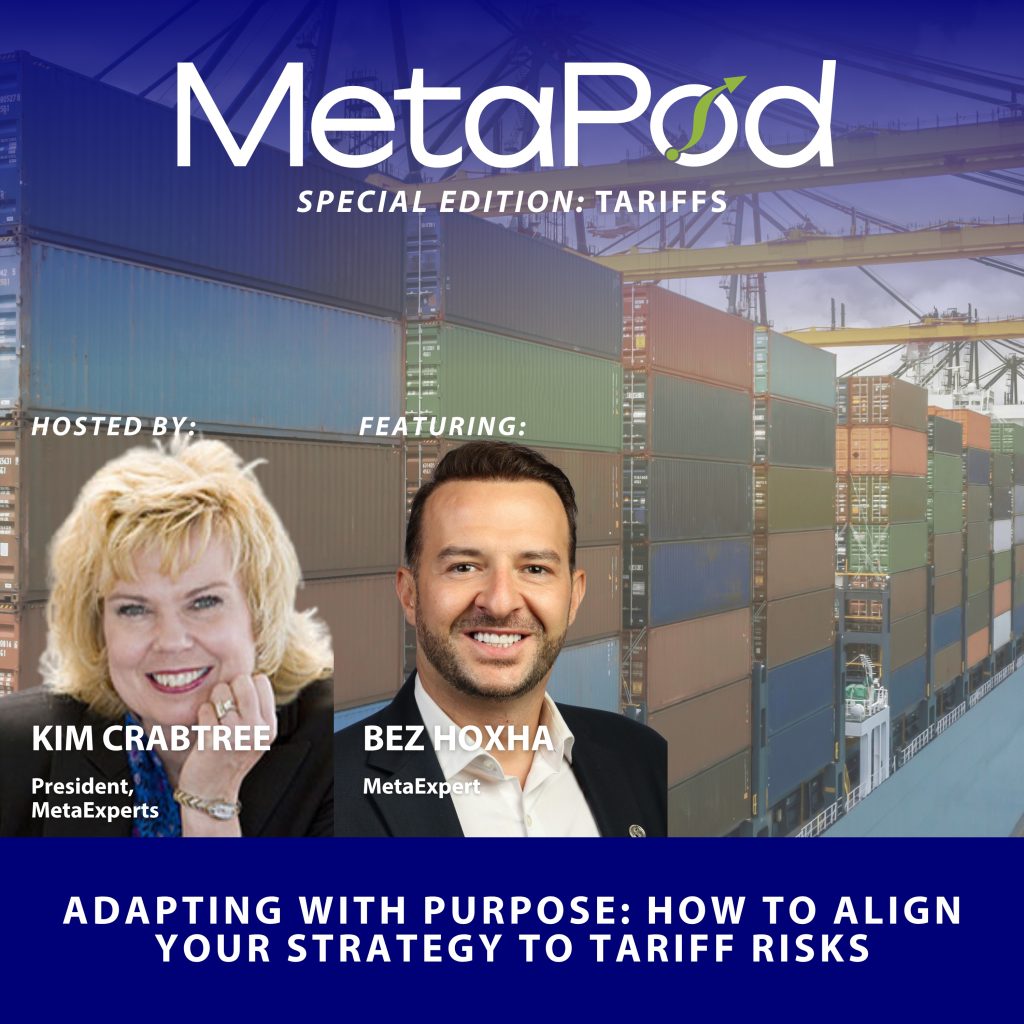
Tariff headlines may come and go, but the operational shock waves can rattle margins for years. In this MetaPod special-edition episode, MetaExperts’ Kim Crabtree sits down with management consultant Bez Hoxha to unpack a practical framework for companies that need to relocate, diversify, or simply stress-test their global supply chain strategies to align with tariff risks.
Quantify the Pain
Bez’s first step is simple: model the financial hit. By drilling down to SKU-level data on Chinese-made drone parts, his team discovered potential 40 - 60% margin erosion across multiple tariff scenarios. Without a granular view of landed costs – duties, freight, lead-time penalties – companies can’t make fact-based relocation decisions. Try pairing your tariff impact model with scenario planning software to see how duties, currency shifts, and logistics spikes compound each other.
Evaluate Alternative Footprints
Once the Numbers are clear, the next move is scouting strategic alternatives:
- Near-shoring assembly to Mexico or Canada for USMCA benefits
- Joint ventures with compliant partners in Southeast Asia or Europe
- Final assembly shifts to “friend-shoring” regions that satisfy export control rules
For a current client, Bez benchmarked four compliant regions before recommending a phased move, which is proof that diversification is not one-size-fits-all.
Map Operational Dependencies
Relocation fails when companies underestimate the spiderweb of dependencies, including everything from battery certification to chip licensing. Bez advises mapping the entire value chain and identifying which modules are flexible, meaning they can move quickly with minimal redesign, and which are fixed, meaning they are constrained by IP licenses, tooling, or safety approvals. This segmentation highlights “quick-win” components versus long lead time bottlenecks.
Stress-Test Risk Scenarios
Even the best plan can stall on red tape or talent gaps. Bez’s team runs risk simulations such as:
- Export-license delays for avionics
- Local workforce training shortfalls
- Certification holdups for critical sensors
By frontloading “what-if” analyses, companies can build buffers like extra safety stock, phased licensing, or cross-trained technicians, before flipping the switch.
Lock Down Legal & Compliance First
Many relocations implode because legal diligence is treated as an afterthought. Bez recounts a 2024 drone-maker disaster where the firm shifted assembly to Southeast Asia without export-control clearance, triggering six-month licensing delays and a costly unwind.
Key compliance pillars include:
- Export-control expertise: Engage firms fluent in ITAR, EAR, FAA, and DOD rules.
- Airtight contracts: Prevent IP leakage through strict licensing terms.
- Customs alignment: Pre-validate component HS codes and country-of-origin declarations.
Additionally, watch out for:
- Cultural fit with JV partners: This is critical as misalignment can torpedo timelines.
- Customer buy-in (FAA, DOD, or commercial buyers): This ensures relocated parts will be accepted at certification.
- Transparent messaging: This keeps shareholders calm when tariffs force rapid pivots.
Short, Mid, and Long-Term Strategy
Bez stresses the importance of layered horizons within your strategy. For example:
- Short term: Non-China outsourcing for immediate tariff relief
- Mid-term: Regional hubs with government incentives
- Long term: Domestic manufacturing once cost curves flatten
This tiered approach balances cash flow today with resilience tomorrow.
Connect and Learn More
We know tariff risk can feel like a ticking clock, but following these steps can help align your strategy to tariff risks. If you have further questions about future-proofing your supply chain, you can connect with Bez and other MetaExperts at metaexperts.com
MetaPod offers a wealth of knowledge and expertise for operational executives and organizations seeking to optimize their operations and supply chains, as well as common challenges such as digital transformation, the forever labor shortage, and doing more with less. Listen and subscribe today for more insightful and engaging discussions on operational excellence, leadership, growth strategies, and organizational transformation.